
A Quiet Challenge at the International Karate Championships
March 20th, 1969, Long Beach, California, was a day that would forever be etched into the history of martial arts. The International Karate Championship finals were underway, and the competition was fierce. Among the crowd of 500 spectators were competitors from 12 different countries, each representing their style and skills, including Shotokan, Goju, Ryu, Kyokushin, and Tangsuo. It was the biggest martial arts tournament in the United States, and it attracted both seasoned masters and passionate students of the discipline.
In the midst of this charged atmosphere stood Michael “The Destroyer” Chen, the reigning champion, who had dominated the tournament for years. At 28, Michael was undefeated, with 47 consecutive victories under his belt. His skills in Shotokan karate were unmatched, and his reputation had grown to legendary status. Tall, muscular, and confident, Michael’s presence commanded attention as he warmed up for the championship bout.
The arena was filled with excitement as spectators watched Michael practice his strikes with precision. His technique was flawless—deep stances, powerful movements, and explosive strikes. His immaculate form was a testament to the years of hard work and dedication he had put into mastering his craft. He moved with the grace of a champion, and his confidence oozed from every action.
As was customary before the finals, the reigning champion took the microphone to address the audience. Michael, standing at the center of the stage, delivered his speech with authority. “Ladies and gentlemen, martial artists, fellow competitors,” he began, his voice booming through the arena. “I stand here today as your three-time champion. 47 consecutive victories, and five years undefeated.”
The audience, full of both admiration and nervousness, applauded politely. But Michael didn’t stop there. He went on to make a bold declaration. “I have proven that Shakan karate is the superior martial art. Japanese karate is the most effective fighting system in the world.” The words struck a nerve, especially for those in the crowd who practiced other martial arts. It was a statement that held weight, but it also carried the potential for conflict.
As Michael continued, his tone became more confident, almost arrogant. “I’ve faced every style, defeated every challenger. And I will continue to prove that traditional Japanese karate cannot be beaten,” he declared. The room grew quieter. Some in the audience were beginning to feel uncomfortable with his words, sensing the disrespect he was showing toward other martial arts.
But Michael wasn’t finished. “There’s something that’s been bothering me lately,” he said, his voice now dripping with disdain. “This new trend of so-called kung fu, Chinese martial arts. All those flashy movements and unrealistic techniques. Kung fu isn’t real martial arts. It’s performance. It’s dancing. It has no practical value in real combat.”
At this moment, a quiet man sitting in row 14, just outside the spotlight, shifted in his seat. His friend, sitting next to him, recognized him and whispered, “You want to leave?” The man, however, shook his head and stayed still, listening intently to Michael’s speech.

The Unexpected Interruption: A Martial Artist Steps Forward
Michael’s words hung in the air like a challenge. “I challenge any kung fu practitioner. Any Chinese martial artist to come up here and prove me wrong. Show me that kung fu actually works against real karate. I’ll even go light. I won’t use full contact. I just want to demonstrate that kung fu cannot compete with karate.”
The audience went silent. This was a rare moment in the world of martial arts, where a champion of such magnitude openly challenged another style, especially one as respected as kung fu. The tension in the arena was palpable. The challenge was out in the open, and the room waited for a response.
Then, unexpectedly, a voice came from the back of the room. It wasn’t loud or aggressive, but it carried clearly across the arena. “Excuse me, I said I’ll take your challenge,” the voice said calmly.
Michael turned around, squinting toward row 14, trying to make out the figure who had spoken. The man who stood up was dressed simply—black pants, a black shirt—nothing that identified him as a master of any particular style. No uniform, no belt, no patches to indicate his rank. At first glance, he looked like just another spectator in the crowd.
Michael, puzzled, asked, “Do you practice kung fu?”
The man shook his head slightly. “I practice martial arts,” he replied, his voice steady and calm.
“What style?” Michael pressed.
“My foundation comes from Tang Sudo, but I also developed my own system,” the man responded, still not revealing his identity.
The room was filled with hushed whispers. Who was this man? Why had he stepped forward to challenge the reigning champion? And what was this “own system” he claimed to have developed?

The Showdown: The Man Behind the Challenge
The tension in the arena was electric. The crowd, initially unsure of what was happening, began to stir. Everyone was waiting to see what would happen next. Michael, confident in his superiority, seemed unbothered by the interruption, but there was a hint of curiosity in his eyes. Who was this man who dared to challenge him?
The man from row 14 stepped forward, still calm, but with a sense of quiet resolve. The arena buzzed with anticipation as he walked toward the stage, still in his simple clothes, the quiet stranger now at the center of attention.
As the two men squared off, the atmosphere shifted from one of competitive bravado to one of raw, unspoken tension. This wasn’t just about a fight; this was about proving something deeper. Michael had belittled kung fu, calling it a dance, a performance. Now, the moment of truth had arrived.
The Unseen Power: What Happened Next
The fight that followed would become a moment that no one present would ever forget. The man from row 14, who was none other than Chuck Norris, would go on to demonstrate not only the effectiveness of his martial arts style but also the deep philosophical approach that separated real martial artists from those who simply sought to entertain.
In those few minutes, Chuck Norris proved to Michael, and to the entire audience, that kung fu was not just a series of flashy movements—it was a formidable fighting style. The audience watched in awe as Chuck’s calm and precise movements dismantled Michael’s bravado, showing that true martial arts was more about skill, discipline, and respect than about loud boasts and arrogant challenges.
The aftermath of this moment was immediate. Michael’s arrogance had crumbled, and the crowd erupted in applause, not for the spectacle of the fight, but for the demonstration of true martial skill. Chuck Norris, a quiet man in the crowd, had just delivered a lesson that no one would forget.
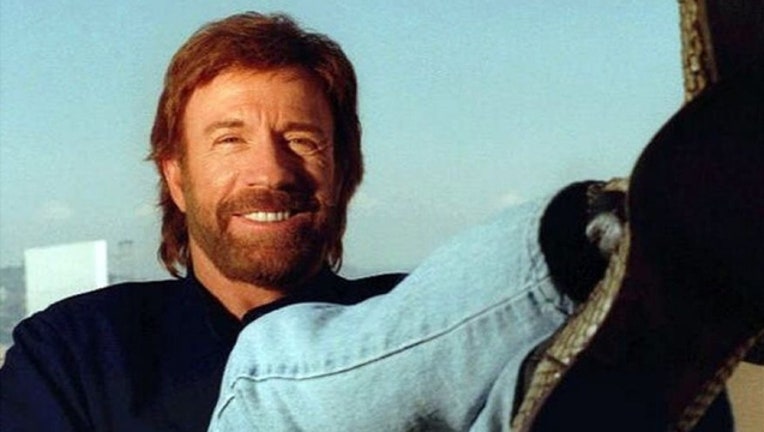
A Legendary Moment: The Aftermath
What happened on March 20th, 1969, wasn’t just about a physical fight—it was a pivotal moment in martial arts history. Chuck Norris, stepping forward with calm confidence, had proven that true martial arts wasn’t about the flash or the spectacle—it was about humility, discipline, and the ability to stand your ground when the time comes. Michael, once the undisputed champion, was humbled in front of an audience that had come to witness greatness, and in doing so, they saw something even greater: respect.
For Chuck Norris, this moment was just one of many in his legendary career, but for those in the audience that day, it was a turning point—a reminder that true mastery lies not in the loudest voice, but in the quietest actions.