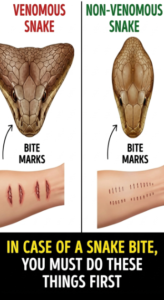
Snake Bite: 6 Actions That Can Really Make a Difference
You’re enjoying a beautiful day outdoors when suddenly, the unthinkable happens: a snake bite. Panic can set in immediately. There may be fear, confusion, and a rush of questions about what to do next. Yet this is exactly the moment when calm, deliberate action matters most. Instead of running around frantically or relying on first-aid techniques remembered from movies, the priority is to keep the bitten person as still and calm as possible while arranging urgent professional medical care.
A snake bite should always be treated seriously. It can be difficult to determine immediately whether venom has actually been injected, and the appearance of the bite does not reliably tell you how serious the situation may become. A person may initially have only small puncture marks, mild pain, redness, or swelling, while more significant symptoms can develop later.
The safest approach is therefore simple: assume that a potentially venomous snake bite requires urgent medical evaluation. Do not wait for dramatic symptoms before seeking help. Prompt access to professional treatment is one of the most important factors after a suspected venomous snake bite.
Snake bites can happen closer to home than expected
Many people associate snake bites with remote wilderness, hiking expeditions, or deep countryside. In reality, encounters can also occur much closer to homes. Gardening, clearing vegetation, moving stored materials, walking through a yard, or working around places where snakes may shelter can all bring people unexpectedly close to one.
Snakes may be difficult to notice because they can remain hidden around vegetation, rocks, piles of material, or other sheltered areas. A person may therefore get too close before realizing a snake is present. Outdoor work deserves particular attention because hands, feet, arms, and legs are often the parts of the body closest to places where snakes may be concealed.
Protective clothing is also useful when working outdoors in areas where venomous snakes may occur. Sturdy boots, long trousers, and appropriate gloves create an additional physical barrier between the skin and the environment. The CDC specifically recommends boots and long pants for outdoor work and protective gloves when handling brush or debris.
Two possible situations, but one important rule
Not every snake bite results in venom being injected. A so-called dry bite occurs when a venomous snake bites without delivering a significant amount of venom. A person may still notice fang marks, discomfort, redness, or other local changes.
The difficulty is that you usually cannot determine safely at the scene whether a bite is truly dry. That distinction belongs in the hands of medical professionals who can assess the person, monitor symptoms, and provide treatment when necessary.
With an envenomating bite, symptoms vary depending on the snake, the venom involved, the location of the bite, and other circumstances. Possible effects may involve swelling, pain, nausea, neurological problems, breathing difficulties, bleeding abnormalities, weakness, or other systemic symptoms.
Some serious bites may initially look surprisingly minor. A small mark does not necessarily mean a small problem. For that reason, waiting for the bite to become obviously severe is not an appropriate strategy. Seek medical help promptly after a suspected bite from a venomous or unidentified snake.
The 6 essential actions to remember
In the confusion immediately after a bite, complicated instructions are difficult to remember. These six basic principles focus on preventing further harm and helping the person reach appropriate medical care as safely as possible.
- Call emergency services immediately.Do not wait for severe symptoms to develop before asking for help. Contact local emergency medical services and explain that a snake bite has occurred. Give the location clearly and follow the instructions provided by the dispatcher or poison-control professionals in your area.
Prompt medical treatment matters because significant envenomation can progress over time and may require antivenom or other hospital-based care. The person should not drive themselves to the hospital, particularly because dizziness, weakness, fainting, breathing problems, or other symptoms can develop.
- Keep the bitten person calm and as still as possible.Unnecessary movement should be minimized. Have the person sit or lie down safely and avoid walking around unless there is no safe alternative. If the bite involves an arm or leg, keep the limb still and follow instructions from local emergency professionals regarding positioning or immobilization.
Immobilization is recommended because muscular activity can contribute to the movement of venom through the lymphatic system. If professional help can come to the person, it is generally preferable to bring transport to them rather than making the bitten person walk unnecessarily.
Remove rings, bracelets, watches, anklets, or other tight objects from the affected limb before swelling becomes significant. Items that initially feel loose can become dangerously restrictive if the surrounding tissue swells.
- Do not cut the wound, suck out venom, or apply a tight tourniquet.These techniques have appeared for years in movies, television programs, and old first-aid advice, but they can cause additional injury without providing meaningful benefit.
Do not make cuts over the fang marks. Do not try to squeeze the area. Do not place your mouth over the wound in an attempt to remove venom. Do not apply an arterial tourniquet or anything tight enough to stop blood flow to the limb.
Health authorities specifically warn against cutting wounds, attempting to suck out venom, and using tight tourniquets because these measures can be ineffective or harmful.
Understanding pressure immobilization
Pressure immobilization is one area where snake-bite advice must be treated carefully because recommendations vary according to the snake species and the type of venom common in a particular region.
A pressure immobilization bandage is not a universal treatment for every snake bite. The World Health Organization notes that this technique is mainly recommended in particular circumstances involving predominantly neurotoxic venoms and may be inappropriate for snakes whose venom causes substantial local tissue damage.
This distinction is important. Advice commonly given in Australia, for example, may not automatically be appropriate for a snake bite in North America, Africa, Asia, or another region. First-aid recommendations can depend on which medically important snake species occur locally. The CDC similarly advises that snake-bite first aid can vary depending on the type of snake involved and that local qualified medical guidance should be followed.
- Use a pressure immobilization bandage only when appropriate for your region and when advised by local medical guidance.Where pressure immobilization is the recommended first-aid technique, the aim is to restrict lymphatic movement while maintaining blood circulation. The bandage should not function as a tourniquet and should never be tightened enough to cut off the pulse or blood supply.
Once an appropriate pressure immobilization bandage and splint have been applied, they generally should remain in place until the person is being managed in an appropriate medical setting. Australian resuscitation guidance specifically emphasizes keeping the person and affected limb completely still and avoiding removal of the bandage before medical evaluation.
If you are uncertain whether pressure immobilization is appropriate, follow the instructions of emergency services rather than improvising. Different snake venoms can produce very different patterns of injury, which is why a technique suitable for one region should not automatically be applied everywhere.
- Do not experiment with the bite site.Do not repeatedly touch, rub, massage, cut, squeeze, or manipulate the bite. The focus should remain on keeping the person calm and still while medical help is arranged.
Advice about washing the bite can differ according to regional treatment protocols. Australian pressure-immobilization guidance traditionally recommends leaving the bite site unwashed because venom residue may assist identification, while current CDC guidance for snake bites in the United States recommends washing the bite with soap and water and covering it with a clean, dry dressing.
That difference illustrates why local emergency instructions are so important. Rather than applying a rule learned from another country, follow the snake-bite guidance used by medical professionals where the incident occurs.
Regardless of region, attempting to suck venom from the bite is not recommended. It does not provide an effective way to remove injected venom and can delay more important measures.
- Do not attempt to catch or kill the snake.Once the bitten person is safely away from the snake, do not approach it again. A second bite turns one medical emergency into two.
If the snake can be observed or photographed from a genuinely safe distance without moving closer to it, that information may sometimes assist medical professionals. However, obtaining a photograph is never more important than personal safety.
Never try to pick up, trap, handle, or kill the snake for identification. This warning applies even if the snake appears dead. The CDC specifically advises people not to attempt to trap or handle a snake after a bite.
Antivenom selection and other treatment decisions should be made by qualified clinicians using the information available to them. Antivenoms are not universally interchangeable; appropriate products are selected according to medically important snakes and venoms found in a particular region.
What symptoms should you watch for?
While waiting for professional help, stay with the bitten person and observe them closely. Do not interpret the absence of immediate dramatic symptoms as proof that everything is fine.
Depending on the type of venom involved, symptoms can affect different parts of the body. Local pain or swelling may occur, but venom can also affect the nervous system, blood clotting, muscles, circulation, or breathing.
Changes such as increasing weakness, difficulty breathing, vomiting, altered consciousness, vision problems, unusual bleeding, or rapidly developing swelling are reasons for particular concern. Tell emergency professionals about any changes you notice.
If vomiting occurs and the person becomes unable to protect their airway normally, positioning may need to be adjusted. WHO guidance recommends closely monitoring breathing and airway function while arranging urgent transport.
Preparation makes emergencies easier to manage
Knowing the correct response before an emergency occurs can reduce confusion when every decision suddenly feels urgent. Snake-bite first aid is not about performing complicated procedures. In most situations, the priorities are much simpler: get away from the snake, obtain professional help, minimize movement, prevent additional injury, and avoid outdated remedies.
Families who live, work, hike, garden, or spend time in areas where venomous snakes are present can benefit from discussing these steps in advance. Make sure everyone knows how to contact local emergency medical services and where basic first-aid supplies are kept.
If you regularly travel to areas where venomous snakes are known to occur, it can also be useful to know in advance where the nearest suitable medical facility is located. In remote areas, planning transportation before an emergency occurs can be particularly important. The CDC advises travelers in snake-risk areas to learn about nearby medical facilities and the availability of appropriate treatment.
Simple prevention habits outdoors
- Wear appropriate footwear. Sturdy boots provide more protection than open footwear when walking or working in snake habitat.
- Wear long trousers when appropriate. They provide an additional barrier when moving through vegetation or working outdoors.
- Use protective gloves for outdoor work. This is especially useful when moving brush or debris where an animal could be hidden.
- Look before reaching into concealed spaces. Avoid placing hands blindly into vegetation, piles, or sheltered areas.
- Keep outdoor storage areas orderly. Reducing clutter can remove some of the sheltered spaces where snakes or the rodents they prey on may hide.
- Never deliberately approach a snake. Give it space and allow it to move away whenever possible.
Common mistakes to avoid
Fear often encourages people to do too much. With snake bites, unnecessary interventions can make the situation worse or delay appropriate medical treatment.
- Do not wait for severe symptoms before seeking medical care.
- Do not encourage the bitten person to walk around unnecessarily.
- Do not cut or slash the bite.
- Do not attempt to suck out venom.
- Do not apply a tight arterial tourniquet.
- Do not use ice, electric shock, or unproven traditional remedies.
- Do not chase, trap, handle, or kill the snake.
- Do not assume that a small bite mark means the bite is harmless.
These precautions keep attention where it belongs: on the safety of the bitten person and rapid access to appropriate medical care. WHO and CDC guidance consistently emphasize prompt treatment, immobilization or reduced movement, and avoiding harmful traditional first-aid techniques.
Stay calm, but take every suspected bite seriously
A snake bite is frightening, but panic does not improve the situation. Calm action does. Move away from immediate danger, contact emergency services, keep the person still, remove constricting objects before swelling develops, and avoid improvised procedures that can cause additional harm.
Most importantly, remember that snake-bite first aid is not identical everywhere. Pressure bandaging, wound care, and other details can depend on the medically important snakes in the region. Follow local emergency and poison-control guidance whenever it is available.
Preparation also creates peace of mind. Sharing these principles with family members, keeping emergency contact information accessible, and knowing where first-aid supplies are stored can make it easier to respond sensibly when something unexpected happens.
The best defense against confusion is reliable information—and after a suspected venomous snake bite, the most important destination is appropriate professional medical care.